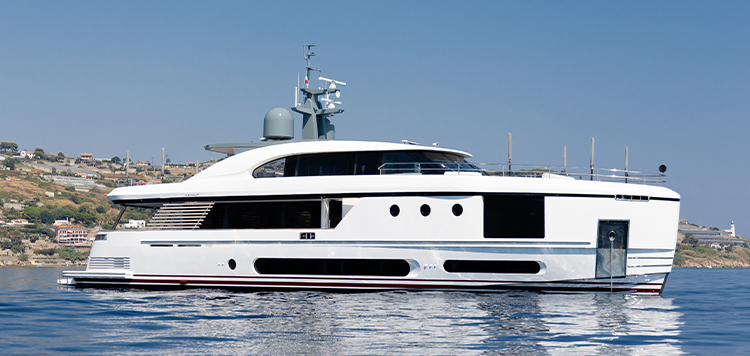
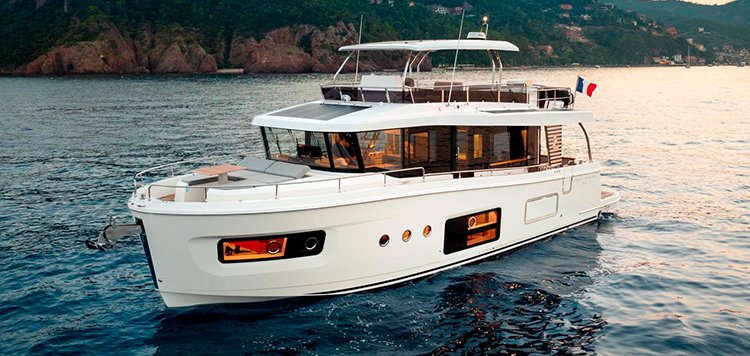
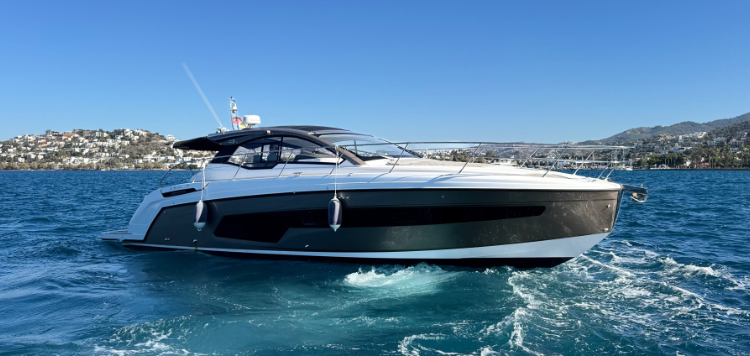
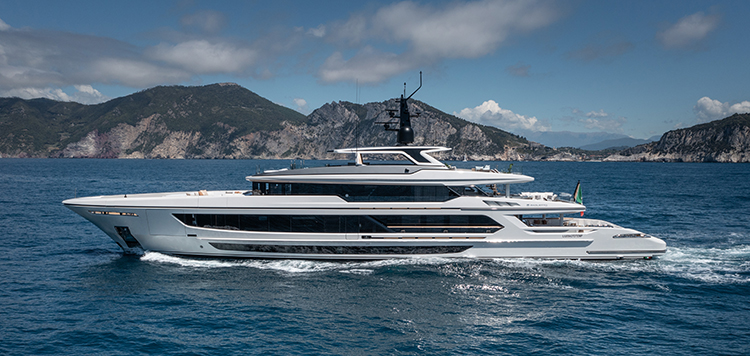
As yachting trends keep changing, the form and functions of tender garages are getting transformed, too. What used to be just a storage space for water toys is acquiring new functions now. Both designers and owners are trying to push the boundaries of what is possible with the help of new ideas and new technologies, in order to make launching and retrieving a tender easier and at the same time to turn the garage space into something useful and original. We have collected the latest trends in tender garages arrangements and how they help to meet their owners’ individual needs.
Beach club
A lot of owners prefer to use the aft of the yacht as a beach club, but stick to the tradition of storing a tender in the aft part, too. In this case designers have a wide range of transformer-solutions.
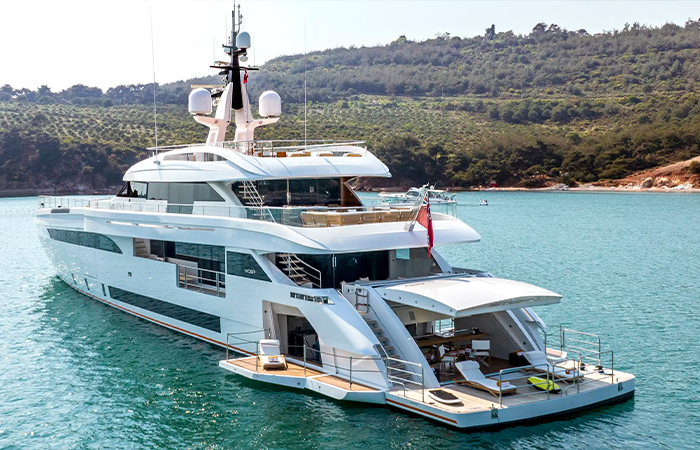
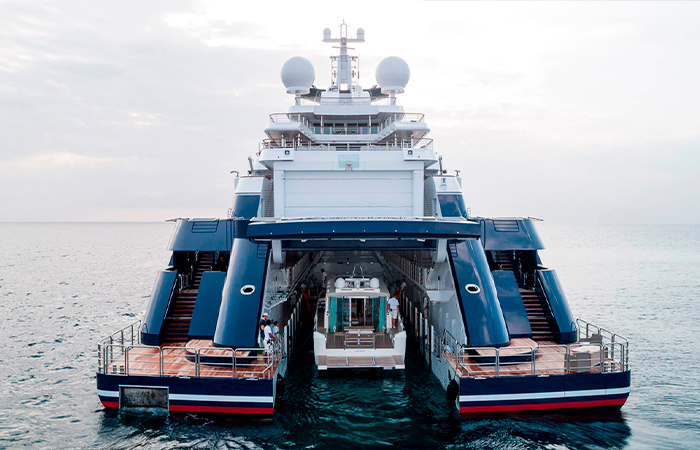
Wider 150 is a fine example of a beach club combined with a tender garage. A float-in dock that takes about one third of the lower deck is large enough to accommodate a 9-meter tender. When it is outside, the aft space turns into a beach club with a sea water pool.
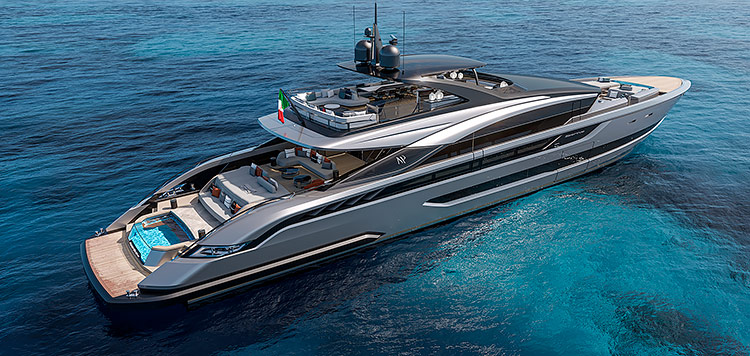
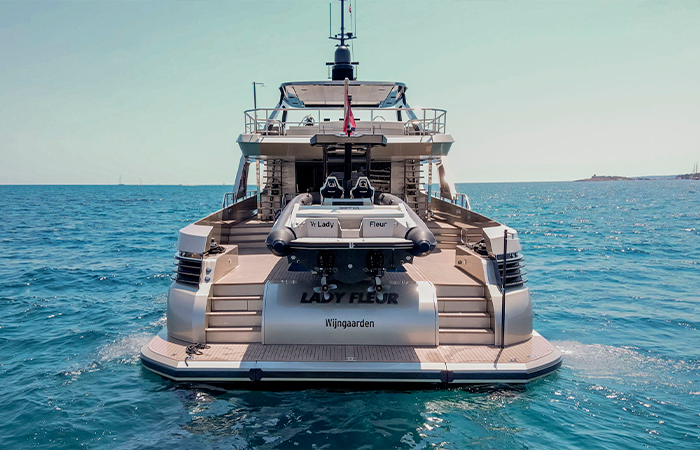
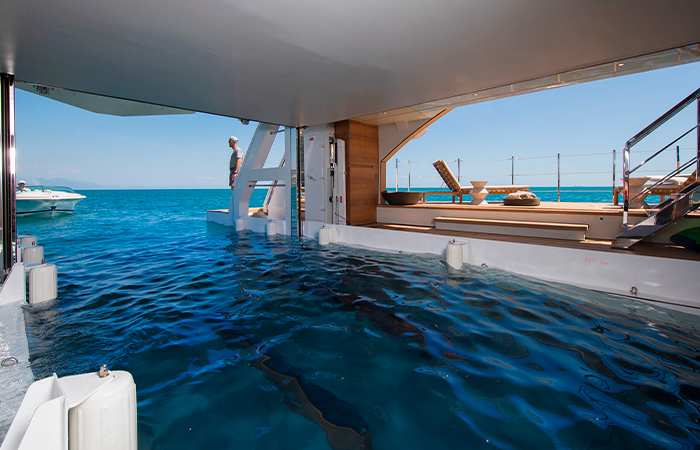
Something similar can be found on a 35-meter Lady Fleur (X-Treme Yachts). The aft center section of the hull lowers and fills with water, allowing the tender to change its location. While the tender is outside, the lower part of the garage rises, turning it into a shallow, secure 11-meter pool that is safe even for younger children.
Seven Sins (Sanlorenzo) ) is another yacht equipped with a floodable dock garage. The water is pumped into the tender bay, and it floats out of the garage. Then a teak platform lowers from above, turning the garage into a beach club. The swimming pool on this yacht is located one level higher.
Side garage
A side garage is another way to free the aft. Designing this kind of garage has its intricacies: some yachts are equipped with water-ballast tanks to make up for the effect of a tender being launched. Side garages normally have gull wing doors. Examples of this type of construction are yacht A (Nobiskrug) and other large yachts.

Transversal garage
A 58-meter Odyssey (CRN) )has a transversal floodable dock garage. The tender gets in through a door to the port. The dock’s capacity is over 18,000 liters of water, which can be pumped out in just 3 minutes. This kind of garage is an ideal fit for a classical 9-meter Riva Iseo that is stored in it.
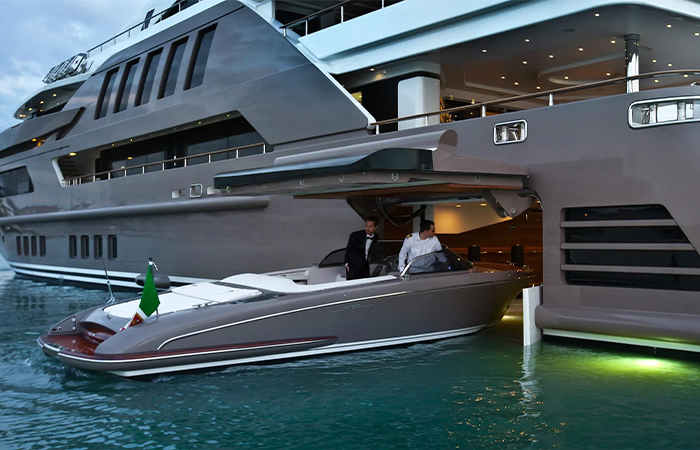
A 40-meter Panam (Baglietto) also has a tender garage fitted transversally in the aft behind the beach club. The garage accommodates a 5.5-meter tender and is partially floodable, which makes it easier to launch and retrieve it with the help of a winch.
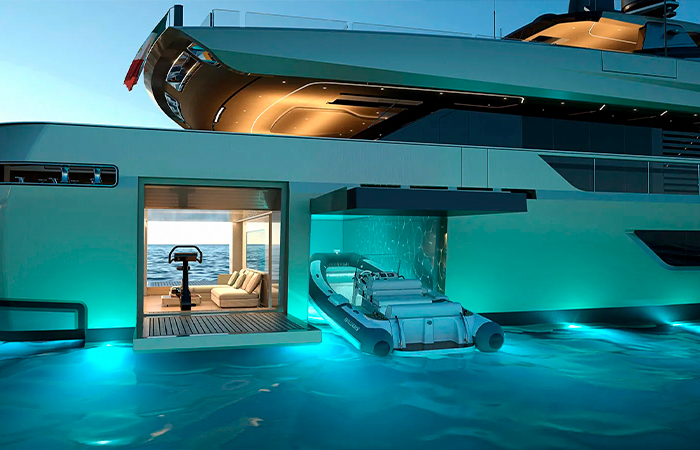
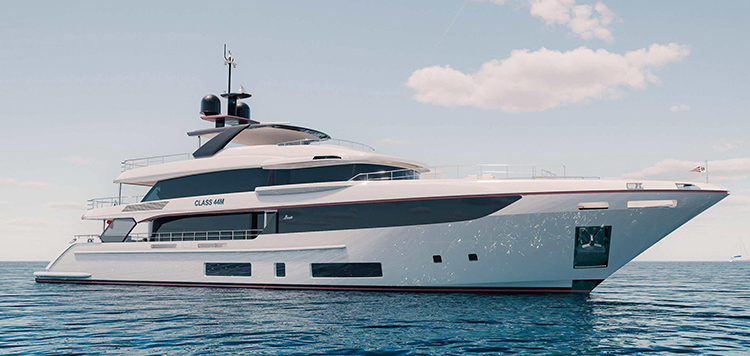
On Benetti Motopanfilo 37M a tender is stored in a dry transversal garage. It is located behind the beach club and is launched onto water with the help of a crane through the side door.
Aft floodable dock garage
A floodable dock garage on a 126-meter Octopus (Lürssen) is 36 meters long and is meant exclusively for storage. In the central part of the garage there are two main tenders. The rest of the fleet is stored in the sections located around the main one. All in all, Octopus accommodates 7 tenders of various size, a submarine, PWCs and other equipment.
Foredeck garage
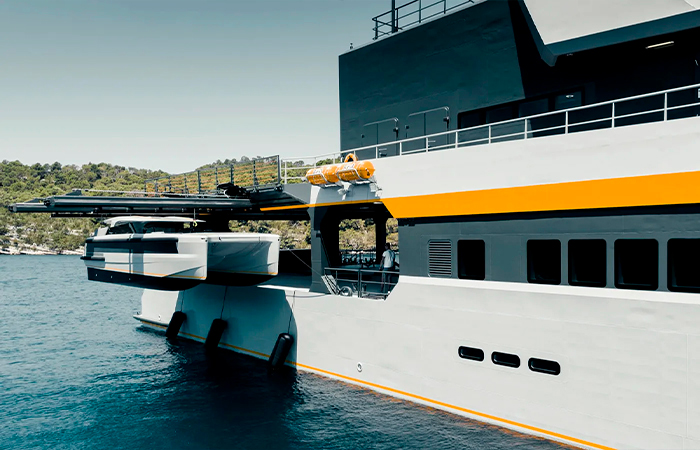
A garage in the bow part of the yacht is another way to free space in the aft. For instance, on a 66-meter Ester III (Lürssen) tender garages are located in the sides of the bow.
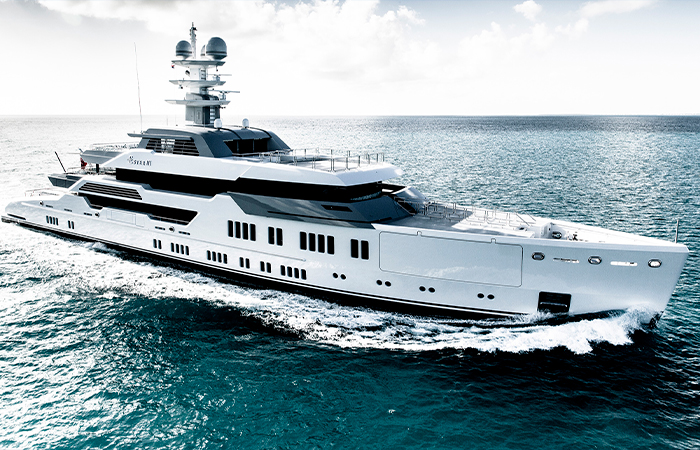
On some yachts tenders and PWCs are stored right on the bow deck and launched with the help of a beam crane.
Apart from storing tenders, owners use garages for absolutely different purposes. Some transport cars and motorcycles in them. Some turn garages into sea water pools, massage rooms, arrange extra galleys, diving centers, gyms or research laboratories. There is nothing left for naval architects to do but to adjust to the owners’ new requests. Some of the latter don’t want any garages on their yacht at all. Then there appears an extra vessel that stores everything that the master boat didn’t accommodate. Such vessels are often called a “floating garage”.
For example, support vessel Nebula (Astilleros Armón) carries tenders on the main deck. It accommodates a 12.3 meters long catamaran, two RIBs and four Jet Skis, a helideck and a helicopter hangar for an Airbus H145.
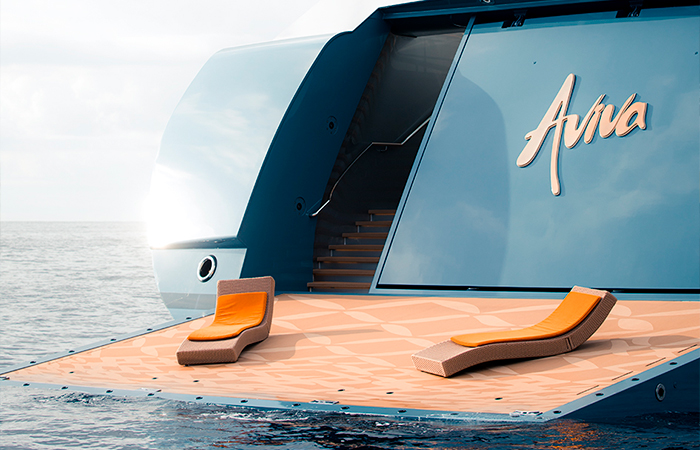
Another example of a non-trivial construction is a 98-meter Aviva (Abeking & Rasmussen) which houses a Padel Tennis court. The court of 20m x 10m x 6.65m is in the widest lower part of the hull. It is certainly not a garage. But one just can’t help mentioning this kind of unique construction, especially since with some modifications the court can be turned into a garage, an oceanarium or something else.
Which tender garage is better
From the viewpoint of convenience of launching and retrieving a tender, experts say that aft garages are at an advantage. Besides, one can service and repair a tender in the aft garage right on the go. Storing on the foredeck often gives more space, but the tender is more exposed to salt water there. Besides, launching a tender on the go from a foredeck is more difficult, particularly when there is a wave. “A battle” for the internal volume of the yacht often leads to a situation, when a tender fits the garage with tolerances of just millimeters. It limits the freedom of maneuvers with a tender and decreases the number of replacement options, as one has to fit particular dimensions. A tender is an important part of a yacht. It is capable of both increasing the pleasure from your yacht and ruining it. That is why professionals advise paying special attention to planning your garage. And it is better to do it at the earliest stages of the project discussion.